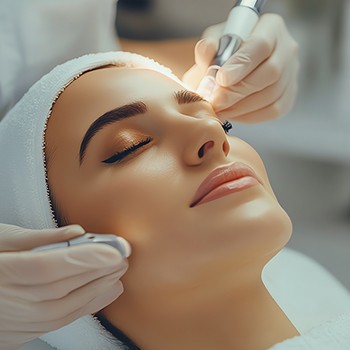
Dermaplaning is a professional physical exfoliation technique that gently removes superficial dead skin cells and fine vellus hair (peach fuzz) from the skin’s surface. It leaves the skin feeling smoother and softer, with a fresh, brighter-looking complexion and a more refined surface.
Benefits
• Smoother, softer skin • Brighter, more even-looking complexion • Improved appearance of dull, rough skin • Better spread and contact of topical skincare • A smooth, even canvas for makeup • Immediate surface-level radiance
Good to know: Dermaplaning does not make facial hair grow back thicker or darker.
FAQs
Dermaplaning is a professional physical exfoliation technique that uses a sterile blade to remove superficial dead skin cells and fine vellus hair from the skin’s surface.
No. It is a superficial, surface-level exfoliation that targets the outermost layer of the skin.
No. It temporarily removes vellus hair. The hair naturally grows back according to its normal growth cycle.
No. Dermaplaning does not change the thickness, colour or growth rate of facial hair. It may initially feel slightly different because the hair has been cut bluntly at the surface.
It is generally well tolerated with minimal discomfort when performed correctly by a trained professional.
Proper dermaplaning should not cause significant bleeding. Minor nicks may occur rarely.
It can improve the appearance of surface dullness and uneven texture, but it does not directly treat deeper pigmentation.
Removing surface buildup can improve the spread and contact of topical products with the skin. It may also be incorporated into certain professional treatment protocols.
It is generally preferable to avoid makeup immediately after treatment, particularly if the skin is sensitive or irritated. Your practitioner will advise you on appropriate aftercare.
Treatments are generally spaced several weeks apart, depending on individual skin condition and your practitioner’s assessment.
No. It may not be appropriate for clients with active acne, open lesions, skin infections, significant irritation or a compromised skin barrier. A professional assessment is recommended before treatment.
Dermaplaning itself does not inherently cause acne. However, performing it over active inflammatory acne can increase irritation and may worsen inflammation.
For a short period after treatment, avoid unnecessary friction, excessive heat, intense exercise and potentially irritating skincare actives, including strong exfoliating acids and retinoids, as advised by your practitioner.
The immediate benefit is smoother, softer and brighter-looking skin, with a more refined surface and an even canvas for makeup.
No. Dermaplaning is a physical exfoliation technique, whereas a chemical peel uses chemical exfoliating agents to produce a controlled exfoliative effect.
OTHER LUXURY DERMATOLOGY SERVICES IN MUMBAI - MYRAH WELLNESS
We use cookies to improve user experience, and analyze website traffic. For these reasons, we may share your site usage data with our social media, and analytics partners. By clicking “Accept Cookies,” you consent to store on your device all the technologies